As AI rapidly advances, it has already started to reshape one of the first industries to adopt the earliest forms of modern AI- healthcare. From chatbots to deal with patient scheduling and primary care to leveraging AI to increase the accuracy of analyzing CT scans and MRIs, it’s clear that AI will continue to have a large role in one of the most traditionally technology-driven industries- healthcare.
In this blog, we’ll talk about some of the aspects of healthcare that AI is already assisting with, and how CodeClouds can help with different aspects of AI integration in healthcare.
How AI is Already Changing the Telehealth Industry?
For the first part of this blog, we’ll talk about the changes companies are already implementing with regards to the telehealth industry.
AI For Patient Portals and Non-Critical Inquiries
The lowest hanging fruit to attack with AI when it comes to healthcare is all of the processes involved in getting care in the first place. One way to do this is by adding AI to patient portals for online care. Healthcare providers already make use of patient portals to allow patients to view their own records, schedule appointments, handle simple tasks like requesting prescription refills, and communicate with their care teams.
While patient portals can handle problems that are medical in nature, the vast majority of the usage will be administrative. Without having AI touch on actual patient care, chatbots can help answer patient questions about appointment scheduling, billing, insurance, payments, the status of their prescription refills, and more. They’re also a large help when it comes to subscription-based healthcare services, or long-term medical needs.
By adding in the option for patients to talk to an AI assistant, you can reduce the call and live chat burden for administrative staff, as well as provide easier access to human assistance for patients who actually need it for their most complex administrative issues. All too often, call centers design their phone systems to be hostile to the caller in order to discourage them from using human resources. Many companies outside of healthcare have taken advantage of AI to further this adversarial relationship. This approach has been aggressively experimented with by companies where the customers are ‘captive’, like ISPs or utility companies. This has led to consumer frustration thus a highly negative sentiment towards AI customer service, and you need to design your AI integration with this sentiment in mind.
Health providers must not take this approach when dealing with patients. Instead, gently encourage trying chatbots. No matter how good AI chatbots get, there will always be three types of inquiries that require human intervention: customers who have fallen through the cracks of the system, service-intensive customers, and medical emergencies or medical questions that are out of the scope of the automated system.
Your chatbots should detect when the customer is trying to ask for medical advice, especially if the system is not meant for that, or is reporting an emergency, and immediately suggest a way to contact a human medical professional if the problem is out of scope. Even if you have a chatbot that is clearly labeled to only be for administrative or billing support services, expect people to ask it about their medical problems. The universe will always send these people to be a liability to both themselves and your company.
Help With Insurance Claims
Insurance is a complex and difficult thing for patients to navigate. Between negotiating with the insurance company, negotiating with the hospital, and navigating the complex network of potential government assistance, it’s no wonder that a lot of hospitals have experts in their billing department whose entire job is to be an advocate for the patient and help them negotiate and navigate through these programs- after all the hospitals would rather get some money over none at all.
AI can help streamline this process. Imagine being able to simply provide a chatbot with your information and it could identify what you qualify for and can do about your medical bills. It could even recommend the right kind of insurance coverage to buy for your medical needs.
Local LLMs for Patient Data Security
You might have read the last sections and wondered how patient privacy plays into that. It’s a concern everywhere as these systems are being rapidly adopted, sometimes in a ‘move fast and break things’ manner. Many countries have strict regulations governing patient data, and what is considered protected patient data varies from place to place. There are restrictions on both how you can handle this data, and what third parties you can send it to.
The answer here is local AI models. These models run on systems you control and are not in control of a larger AI service that is vacuuming up everything entered into them. Despite the name ‘local’, this doesn’t necessarily mean you will buy hardware, shove it in a closet, and maintain it yourself. What this can actually look like depends on your compliance needs and your strategy. It could be as simple as leasing bare systems in the cloud and setting up all of the software and AI models yourself, or it could even be as easy as going with a third-party provider that provides isolated and secure ‘siloed’ AI for your use.
Your regulatory and security compliance needs may vary from case to case and country to country, but as a rule of thumb you should not be slapping your patients' data into the same cloud AI systems that general people use. This applies to billing data as well, as it is often treated the same as medical data. Under HIPAA in the United States for example, medical bills and explanations of benefits are Protected Health Information. Just because your chatbot may refuse to help patients with actual medical issues doesn’t mean you don’t have to treat the conversations like medical records.
How CodeClouds Has Helped Our Clients Leverage AI in Telehealth
As we discussed above, AI chatbots can be useful for several customer service inquiries for telehealth services. We have already been working on several client projects that need an AI chatbot integrated into our clients’ patient portals, and as a result we’ve built an AI for this currently in beta as part of our new telehealth platform.
This chatbot doesn’t provide medical diagnoses, treatment recommendations, or replace anything that the doctors’ role fills, rather it answers non-critical patient questions about the treatment service and the portal. This chatbot is a local LLM, meaning it can run on your own dedicated on-premise or cloud hardware where you are in control of security. It's designed to be HIPAA-compliant and protect personal health information.
AI and Healthcare in the Future
From here, we’ll talk about what the future holds and potential uses of AI in the healthcare industry that are more complex in scope and are still a frontier.
Filling in the Gaps Caused by Staffing Shortages
The 2020 pandemic taught us what can happen to non-lifesaving care when the medical system is stretched thin. When there’s a shortage of doctors, nurses, and even hospital beds your average patient is going to have a hard time getting even a basic prescription. Some of these tasks can be handled via telehealth, and possibly by an AI system as well.
Another thing AI can help with is triage. By connecting first with an AI chatbot powered by something like MedPaLM, a customer can be told if their condition is safe to delay treatment when the hospitals are too crowded, or provide them with basic medical advice that would prevent them from crowding the ER waiting room when they shouldn’t. While some people are too reluctant to seek healthcare, some people are too quick to head to the emergency room for every little ailment.
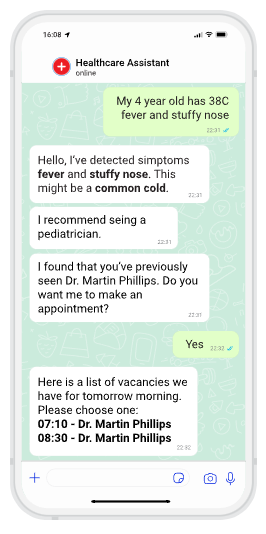
Image from druidai.com
Deep Searching With AI
AI Search is one of the most powerful broad uses of AI when it comes to indexing unstructured or inconsistently structured data. The healthcare industry is no exception to this problem. One particularly difficult area is clinical trials.
At CodeClouds, we’ve been actively building a tool to take an index of clinical trials and allow healthcare professionals to enter their genetic biopsy report, among other details, to match them with potential clinical trials that the patient should qualify for. As precision medicine, particularly cancer treatment, gets more complex, it’s almost impossible for a human to review a patient's genetic mutations, biomarkers, and cancer subtypes against the deluge of trials to see if they both qualify and if it’s a good fit for their case.
Though there are indexes like ClinicalTrials.gov, our tool aims to provide a more detailed search in ways these indexes don’t structure data- diving deep into descriptions and requirements to intelligently provide potential matches. Doctors get a curated list of clinical trials to review for their patients, and are able to spend their time reviewing likely matches instead of finding them in the first place, leading more patients to have access to cutting-edge care from clinical trials than they otherwise would have.
This project isn’t ready for prime-time yet, but we’ll be updating our blog as our tool passes its own trials.
How We Can Help With More Complex AI Healthcare Applications
Our Enterprise Division is able to take on a variety of complex projects. We aren’t the ones you should talk to about solving cancer with AI. We are not healthcare researchers. What we are is a custom software development company. We don’t just handle typical telehealth projects that can be solved by our frameworks or software products. We can take your new AI healthcare proof of concept and help develop it into a custom platform, complete with any integration and workflow you may need. We are not developing the AI tools to do things like analyze patient scans, but we can take these tools and build a platform around them, and make sure they’re deployed in a scalable, robust, and secure way.
Our project discovery process ensures you have expert consultation and a concrete plan in place for how to proceed with your project. We have different engagement models depending on what your custom software needs are, including outcome-based delivery, a dedicated team for you to manage, or staff augmentation for your in-house development.
In Conclusion
The way AI can help is not totally understood for every application yet, and is different on a case by case basis. But leveraged correctly, it’s invaluable in finding conclusions that we may have already come to, but quicker. We often look at big data as exclusively a business thing driven by profits but the medical field, both profit-driven drug companies and non-profit-driven research deal with some of the same challenges when it comes to making use of massive amounts of data.
The biggest advancements in modern medicine often come from finding a way to interpret extreme amounts of data, or by feeding organized data into an AI model and seeing what it does with it. AI has the potential to notice patterns before researchers can, and this is crucial when it comes to finding the most promising candidates for drugs.
How CodeClouds Can Help Your Healthcare Project
If your healthcare company is looking for a team that can integrate some of the things mentioned in this article, or other more traditional non-AI solutions, CodeClouds has integration services for the healthcare industry. You should send us an email!
If you’re in the telehealth space, we already have multiple platforms designed to launch your platform faster while still maintaining customization and giving you more control.

We specialize in patient portals and subscription-based treatments, and have already helped clients get the most out of AI integrations to these portals. Using the lessons we’ve learned from helping telehealth providers, we’ve developed the Unify Framework for Healthcare, a framework that helps typical clients be ready to launch in a matter of weeks instead of months.
In addition, we’ve been hard at work developing AsterMD which is set to launch later this year. While Unify Framework for Healthcare is designed to let us develop custom platforms for clients faster and more reliably, AsterMD is a more out-of-the-box solution. It is a complete headless API-First telehealth platform. It handles every stage of the patient's healthcare journey from the landing page through to fulfillment on a single platform. It’s built to have everything you need for an end-to-end patient experience, just slap your own front-end on top. We can, of course, still develop your front-end for you too.


Summarize Article with AI